
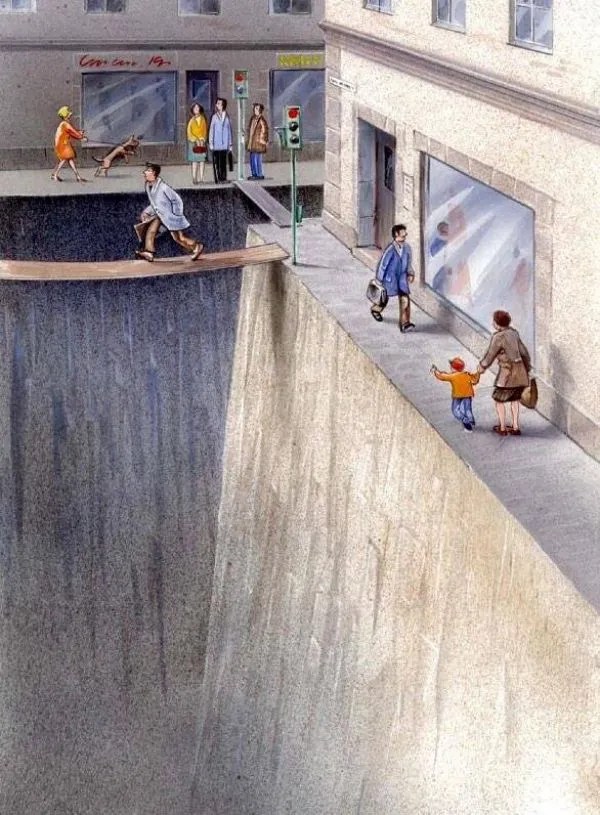
I often find myself reflecting on this illustration by Karl Jilg.
To me, it perfectly captures what it feels like to walk in North American cities, where it sometimes seems like pedestrians are an afterthought. We’re squeezed onto narrow strips of pavement while the rest of the city is dominated by roads designed for cars.
Tiny sidewalks make the city feel less inviting. There’s little room to pause, chat with a neighbour, or browse shop windows. Instead, it feels like you need to keep moving, to get off the street as quickly as possible.
What if we eliminated the concept of sidewalks? I know, you might be thinking, “Wouldn’t that mean even less space for pedestrians?” But stay with me for a moment.
There’s actually a concept called “shared streets” that’s already in practice in cities in Japan and Sweden. The idea is to level the entire street so that pedestrians, cyclists, and vehicles all share the same space. The traffic lane is narrower, lined with trees and other features, and the road surface changes with different patterns of cobblestones to signal that you’re in a different kind of area. Crucially, pedestrians always have the right of way.
What I love about this concept is that it allows people to walk wherever they like. You’re not confined to a narrow sidewalk; the whole street becomes a place where you can stroll, gather, and just be.
Think about bustling streets around the world, filled with restaurants, bars, and shops. They’re often so lively that the sidewalks can’t handle all the foot traffic, and people spill into the streets, sometimes dodging cars or bikes. This competition for space often leads to jaywalking and, unfortunately, more accidents. By not prioritizing pedestrians, we create more congestion and danger.
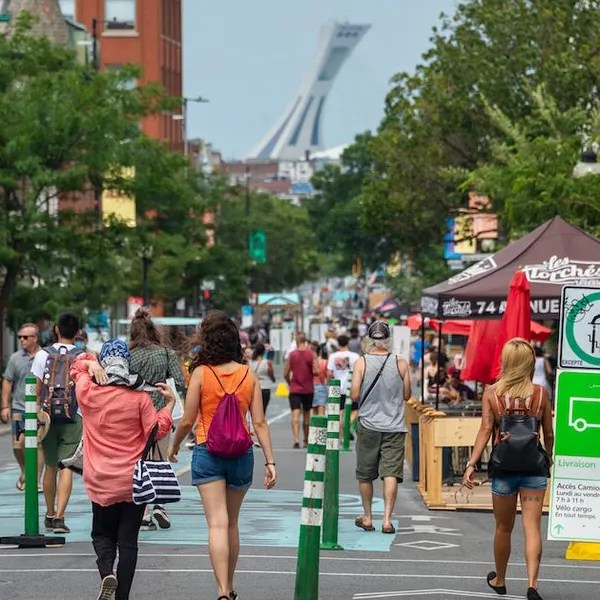
At times, I wonder if shared streets could work in North America, where I live with its wide streets designed for cars to zoom from one side of the city to the other. But then I think about places like Montreal, where 11 streets are closed to cars every summer, including some major ones. These streets seem like prime candidates for becoming shared streets. Cars would still be allowed but would likely avoid them because they’d have to follow the pace of the pedestrians.
A beautiful effect of shared streets was observed in Poynton, England, after the City redesigned a busy intersection. When everyone—drivers, cyclists and walkers alike—was on the same level, a sense of consideration emerged. No one was battling for space, and traffic, both foot and vehicle, flowed more smoothly. The shared street even reduced frustration, and the area became more popular as people wanted to spend time in this friendlier, quieter space.
It made me realize that the way we design our streets, with cars speeding through and pedestrians rushing to get out of the way, encourages a sort of hurried, impersonal vibe. Walkers rush to get to their destination, while drivers blitz through traffic lights to shave seconds off their commute. But when a space is shared, when everyone has a place, people start to care about it. A neighbourhood with slower traffic, more trees, less noise, and spaces to relax invites respect and community. When you’re just passing through, it’s easy to be careless. But when a street feels like it’s part of your neighbourhood, you want to take care of it—and each other.


 Gigi On Earth
Leave a reply to Georges GALLAIS Cancel reply